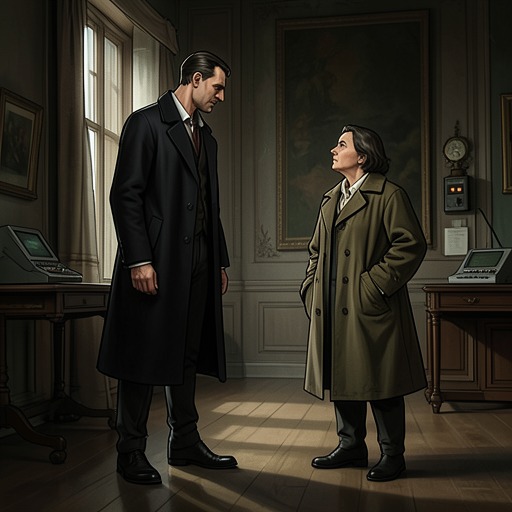
The Ondt and the Gracehoper’s encounter
Finnegans WakeThe Ondt and the Gracehoper’s encounter is an embedded fable that turns a contrast between industrious security and pleasure-seeking dependence into a meeting between former companions. The Gracehoper arrives hungry and without money at the Ondt’s comfortable domain, where he sees the host surrounded by the company and comforts he once enjoyed. His response is neither a clean reconciliation nor a simple defeat: in a long, unstable address, he accepts the Ondt’s reproof and rescue while praising the very order that has left him outside. The encounter makes their opposition a question of time, appetite, debt, and who gets to flourish.
Shaun Introduces the Fable
The episode begins as a performance within Shaun’s speech. Asked to sing, Shaun apologizes and chooses instead to tell a fable of Jacko and Esaup, identifying its subject as the Ondt and the Gracehoper. The frame matters: their dispute is not delivered as neutral reportage but as a tale selected and voiced by Shaun, whose introduction calls attention to its status as a fable even as its proliferating, comic language resists a single tidy lesson.
The Gracehoper’s earlier life is defined by motion, play, and sociability. He is always jigging and making amorous overtures to Floh, Luse, Bienie, and Vespatilla, inviting them into games and courtship. His exuberance extends beyond flirtation: he joins dances and funeral festivities, and the narration associates him with movement, music, and the repeated insistence that time should be kicked along. Pleasure is not a passing diversion for him; it is the organizing habit of his life.
The Gracehoper’s Reversal
Against this restless figure, the Ondt appears as a man of cold spaces and deliberate exclusion. He thinks over whom to admit to his social circle and refuses to welcome the Gracehoper to a gathering. His self-description is expansive and possessive: he imagines his reign flourishing and growing, while the comic sequence of blessing and self-congratulation gives his ambition the sound of a mock proclamation. The Ondt’s authority rests on choosing who belongs and on imagining that his own prosperity can continue without interruption.
The Gracehoper’s carefree habits have meanwhile acquired a cost. He has jangled through love, debts, and life’s doubts, and now falls sick and poor, with nowhere to turn for food or shelter. His complaint that he has no money for even a little bee-bread makes his need bodily and immediate. The reversal is sharp because he once participated in abundance and pleasure; he now lacks the means to meet a basic hunger.
The fable renders that deprivation through an extravagant account of consumption. The Gracehoper has eaten paper, swallowed lustres, devoured flights of staircases, chewed up tables and records, and consumed the very time and place around him. These impossible excesses turn his appetite into an image of expenditure without reserve: he has spent not only material resources but the stuff of his world. At Christmas, with bare branches and severe weather around him, he leaves his cottage, Tingsomingenting, and wanders in search of relief. The seasonal setting sharpens the contrast between the warmth and provision he needs and the cold landscape through which he moves.
The Meeting at the Ondt’s House
The Gracehoper eventually throws himself into the Ondt’s vicinity, wondering where his luck might land and whether his next meeting with his old acquaintance will make a world of difference. He finds the Ondt enthroned in a comfortable, sunlit room, smoking cigars and settled before food. The earlier image of a host who decides who may enter now takes concrete form: the Ondt possesses the domestic comfort and plentiful company from which the Gracehoper has been excluded.
The contrast is also social and erotic. Floh bites the Ondt’s leg, Luse clings to him, Bienie kisses him, and Vespatilla shows him affection. The Gracehoper, who had once courted this company, confronts its attention gathered around his rival. His exclamation at the scene is both comic and pained; what he sees is not merely that the Ondt has food, but that he has assumed the central place in a circle of intimacy and pleasure.
The Ondt relishes the scene rather than acknowledging the Gracehoper’s hardship. He takes pleasure in playing with the women and chasing Floh, tickling Luse, engaging Bienie, and teasing Vespatilla. His ease and self-enjoyment intensify the asymmetry: the Gracehoper has arrived spent and hungry, while the Ondt is a host in possession of leisure, attention, and comfort. Their encounter thus returns the fable to its founding distinction, but now gives that distinction a face-to-face setting.
Reproof, Rescue, and the Unresolved Ending
The Gracehoper’s response changes the register of the encounter. Weeping, he says that he forgives the Ondt and describes him as the keeper under whose protection the others are safe. He asks the Ondt to teach Floh and Luse dances, direct Bienie, and have Vespatilla find suitable partners. The pleas mix forgiveness, practical requests, and surrender: instead of reclaiming his old place, he entrusts the company to the man who has taken it.
The Gracehoper then presents his condition as payment for a lesson. He accepts the Ondt’s reproof as a friend’s gift and calls his own spending the price of the rescue he has received. That formulation acknowledges a reversal in their relation: the former pleasure-seeker now speaks as a dependent, while the Ondt’s wealth and authority appear to make him capable of saving as well as judging. Yet the surrender does not erase the difference between them. The Gracehoper praises the Ondt’s vast domain and powers, then closes his address with the question of why the Ondt cannot keep time. The compliment contains a final barb: mastery of space and worldly success do not necessarily confer command over time.
The ending extends the Gracehoper’s speech into a dense meditation on distance, duration, and unequal reach. He describes the Ondt’s worldwide scope and sublime spaces, but also returns to the image of a blink, a look from afar, and the possibility of finding something hidden behind the other’s apparent fullness. The language alternates between homage and resistance, so the speech cannot be reduced to either simple repentance or triumphant reconciliation. The Gracehoper accepts help and acknowledges the cost of his former life, while his concluding challenge leaves the Ondt’s apparent mastery incomplete.
Form and Significance
The encounter’s moral opposition is carried by its comic verbal excess. The Ondt’s cold spaces, exclusion, and self-proclaimed flourishing answer the Gracehoper’s dancing, spending, and hunger, but neither figure is made into a plain emblem with a stable lesson. The Gracehoper’s expenditure brings genuine deprivation; the Ondt’s order brings comfort and social authority, yet his exclusion of an old companion and his delight in possession complicate any uncomplicated praise of discipline.
The fable also makes its argument through reversals of status. A former lover and reveler becomes a supplicant; a gatekeeping figure becomes a host and rescuer; an apparent act of submission becomes a speech that still measures the limits of the victor’s control. Because Shaun tells the tale as a fable and the Gracehoper answers the Ondt in an extended, shifting poem, the episode presents its conflict not as a settled verdict but as a performance in which pleasure, prudence, need, and time remain in tension.